Healthcare providers can earn American Heart Association PALS certification in Woodland at the Safety Training Seminars training center in historic downtown Woodland on Main Street. The center runs the AHA’s blended HeartCode PALS course. You complete the online portion first, then book a short in-person skills check in Woodland. Once you pass, your official AHA PALS Provider eCard is issued the same day.
That’s a useful checklist. Also confirm the course is from an authorized provider and that your employer accepts its certification. For blended courses, check how the online portion and in-person skills session fit together, and when the eCard is issued.
Why PALS Matters in a Community Hospital Town Like Woodland
Most of Woodland’s acute care runs through Dignity Health’s Woodland Memorial Hospital on Cottonwood Street. Woodland Memorial is a community hospital. It operates a 24-hour emergency department and a family birth center, and it is part of a regional network of Dignity Health hospitals across the Sacramento area. Dignity Health Medical Foundation’s Woodland Clinic locations add primary care, pediatrics, and urgent care in town.
Community settings face a particular challenge with pediatric emergencies. Children who become critically ill are often stabilized locally before they are transferred to a regional pediatric center in Sacramento. That puts the first critical minutes in the hands of local ED nurses, physicians, respiratory therapists, and paramedics. These providers may not see a seriously ill child every week.
That’s a strong point: when pediatric emergencies are uncommon, a shared, practiced approach can help teams recognize deterioration and coordinate care under pressure. For rural EMS crews, training should also reinforce role clarity, communication, stabilization, and transport planning within local protocols. PALS supports clinical readiness, but it doesn’t replace medical direction or regular team practice.
Whether your specific job requires PALS depends on your employer and unit. Check with your manager, clinical educator, or agency before you register.
What the PALS Course Teaches
Pediatric Advanced Life Support (PALS) is the AHA’s advanced course for healthcare providers who care for infants and children in emergencies. It teaches a systematic approach to a deteriorating child.
The Assessment Sequence
PALS starts with a quick general impression of appearance, work of breathing, and circulation. It then moves through a primary assessment using the ABCDE approach: airway, breathing, circulation, disability, and exposure. A secondary assessment and diagnostic tests follow. At every stage, providers learn to evaluate, identify the problem, and intervene, then reassess.
The Core Clinical Problems
The course is organized around the conditions that most often lead to pediatric cardiac arrest:
- Respiratory problems: upper and lower airway obstruction, lung tissue disease, and disordered breathing control
- Shock: hypovolemic, distributive, cardiogenic, and obstructive types
- Rhythm disturbances: symptomatic bradycardia and tachycardia, including SVT
- Cardiac arrest: high-quality pediatric CPR, defibrillation, and medications
- Post-cardiac arrest care: stabilization while preparing for transfer
The course also covers resuscitation team dynamics. Clear roles and closed-loop communication help when the team includes staff who don’t work together every day. Course content follows current AHA science, including the 2025 guideline updates.
Where to Take Your PALS Class in Woodland
The training center is located at 725 Main Street, Suite 227, Woodland, CA 95695, in the historic downtown district. Safety Training Seminars describes the location as near the intersection of Main Street and Court Street, with access from Highway 113. For providers commuting from Davis or traveling down from Esparto or Zamora, that keeps the trip straightforward.
According to the Woodland PALS certification course page, the center lists hours of 8 a.m. to 10 p.m. every day of the week. The same page covers enrollment and notes that Safety Training Seminars offers price matching on its AHA courses. Appointment times and current offers can change, so confirm them when you book.
From Registration to eCard: A Realistic Timeline
Here is roughly how long each part takes, based on Safety Training Seminars’ published course estimates.
| Step | Where | Estimated Time |
| Register and receive HeartCode PALS access | Online | A few minutes |
| Complete HeartCode PALS modules and exam | Online, at your own pace | About 2–3 hours (often longer for first-timers) |
| Hands-on skills check at a CPR Verification Station | Main Street training center, Woodland | About 30 minutes |
| Receive AHA PALS Provider eCard | By email | Same day as skills completion |
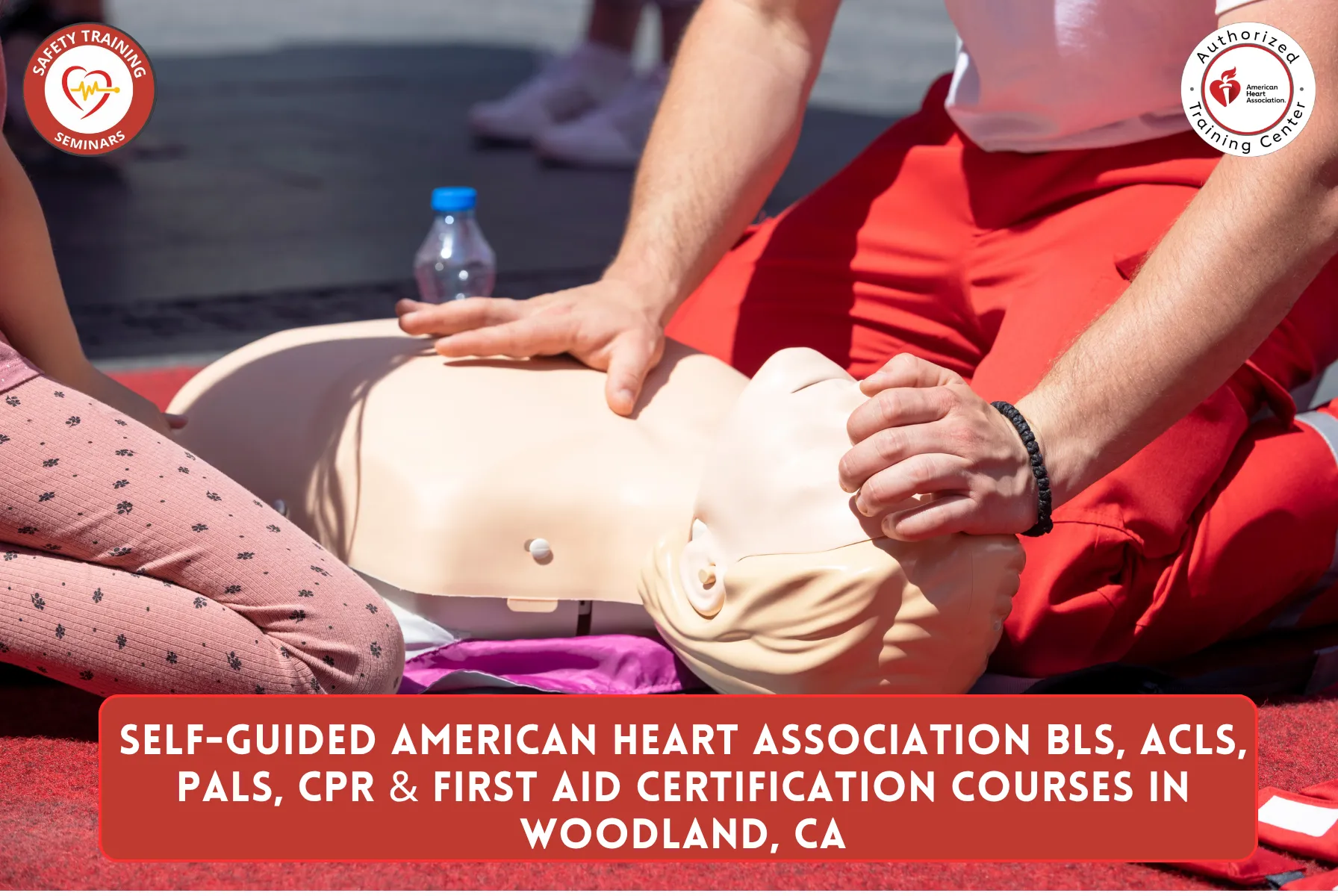
The skills session uses a CPR Verification Station, an AHA-backed system that gives real-time feedback on infant and child compressions and ventilations. According to the training center, you can practice until you reach the required performance level. Many providers break the online work into shorter sessions across a few days off and then schedule the skills check.
Keeping Pediatric Skills Sharp Between Renewals
A PALS card is generally valid for two years. Pediatric resuscitation skills tend to fade much faster than that, especially for providers in low pediatric-volume settings. A few habits help between renewals:
- Review the algorithms periodically. A quick look at the pediatric cardiac arrest, bradycardia, and tachycardia algorithms keeps the decision points familiar.
- Know your department’s pediatric resources. Learn where length-based dosing tapes, pediatric airway equipment, and reference charts are kept before you need them.
- Take part in mock codes. If your hospital or agency runs pediatric simulations, they reinforce team roles and communication.
- Keep BLS current. High-quality CPR is the foundation of every PALS case. Many employers require a separate BLS card.
- Renew on time. Book your PALS renewal a few weeks before your expiration month so a scheduling conflict doesn’t leave you with a lapsed card.
Common Mistakes When Booking PALS
A few avoidable issues come up often:
- Booking the wrong course. Labor and delivery and newborn nursery staff may actually need NRP (Neonatal Resuscitation Program), not PALS. Some roles require both.
- Assuming any card will do. Some employers specify an AHA PALS card or have rules about blended formats. Confirm what your employer accepts first.
- Skipping the pre-course self-assessment. The AHA’s PALS self-assessment highlights gaps in rhythm recognition and pharmacology before they slow you down in the course.
- Waiting until the last week. A tight deadline leaves no room for a reschedule if a shift change gets in the way.
Frequently Asked Questions
Is the PALS course in Woodland an official American Heart Association course?
Yes. Safety Training Seminars uses the AHA’s HeartCode PALS program with an AHA skills verification. Providers who pass receive an American Heart Association PALS Provider eCard.
I live in Davis or West Sacramento. Does it make sense to train in Woodland?
Often, yes. Woodland’s downtown training center is reachable from Davis via Highway 113. Some providers find a Woodland skills appointment fits their schedule better than one in Sacramento.
Can nursing or paramedic students take PALS?
PALS is designed for healthcare providers, but students in clinical programs sometimes complete it before pediatric rotations or job applications. Check with your program or prospective employer to see whether PALS is expected or useful at your stage.
Do I need NRP or PALS if I work in a birth center?
It depends on your role. NRP focuses on newborn resuscitation at and shortly after delivery. PALS covers infants and children beyond the newborn period. Some birth center and nursery staff are required to hold both, so ask your unit educator.
What happens if I struggle during the skills check?
According to the training center, the CPR Verification Station gives real-time feedback and allows you to keep practicing until you meet the AHA performance standard.
Does Safety Training Seminars offer other AHA courses in Woodland?
Yes. The Woodland location also offers BLS, ACLS, NRP, CPR and First Aid, and EMSA childcare training.
Get Your PALS Certification in Woodland
That sounds convenient, but confirm the details directly with the training center before relying on them. HeartCode PALS typically combines online learning with an in-person skills session; session length, location, and eCard timing can vary. Also verify that the course is AHA-authorized and accepted by your employer.
Confirm your employer’s certification requirements, then visit Safety Training Seminars’ Woodland CPR classes site to compare PALS with related BLS, ACLS, and NRP options and choose a Seminar that fits your schedule.